A Gift Card When the Shop Closes
A gift card is not money held for the buyer. It is a promise from a company to supply goods later, and when that company stops trading the promise becomes a claim in a queue where most of the people ahead were owed rather more.

The rule in short
A gift card holder is an unsecured creditor of the issuing business. On a bankruptcy filing, an automatic stay generally prevents redemption unless the court permits it, and honoring cards during a case is a matter for court authorization rather than a right. Bankruptcy law gives individuals a limited, capped priority for deposits made toward the purchase of goods or services for personal, family or household use, which ranks ahead of general unsecured claims but well behind secured lenders.
A gift card is a promise from a business to supply goods or services later. It is not money held on the buyer's behalf, and it is not secured against anything. When the business stops trading, the promise becomes an unsecured claim.
That single structural fact explains almost everything that follows. Employees, landlords, suppliers, tax authorities and above all secured lenders have claims against the same pot, and most of them have better positions. Bankruptcy law does provide a narrow, capped priority for consumer deposits, which improves the position without transforming it.
What happens the moment a case is filed
A bankruptcy filing generally halts collection efforts against the business, including attempts to enforce a claim. Redeeming a gift card is, in substance, enforcing a claim, which is why cards commonly stop being accepted on the day of a filing rather than gradually.
Businesses that intend to keep trading usually apply straight away for permission to honor customer programs. Courts frequently grant it, because a retailer trying to restructure needs customers to keep walking in. The permission may come with limits: a value cap, a requirement to spend an additional amount, or a deadline after which cards are no longer taken. Those limits are conditions of an authorization rather than terms the cardholder ever agreed to.
Where a cardholder ranks in the queue
The default position is a general unsecured claim, which sits behind secured creditors and behind the priority categories the statute lists. Bankruptcy law does, however, give a specific priority to allowed unsecured claims of individuals arising from the deposit of money in connection with the purchase, lease or rental of property, or the purchase of services, for personal, family or household use, where the property or services were not delivered or provided.
Two limits make it narrower than it sounds. It is capped per individual at an amount that is adjusted periodically, so a large balance is only partly protected. And it sits several places down the statutory list, so it only pays if there is anything left after the categories ahead of it. It is a real improvement on a general unsecured claim, and it is not a guarantee of payment.
A liquidation and a restructuring produce very different outcomes for the same card. In a restructuring the business intends to continue, so honoring cards is often in its own interest and courts are receptive to allowing it. In a liquidation the assets are sold and the entity ends, so nobody has a commercial reason to take the card and the holder is left with a claim in a distribution. Reading which kind of case has been filed is therefore the first useful thing a holder can do.
The interval between a company saying it is in difficulty and a filing is usually the last chance to convert a card into goods. Cards are frequently honored right up to a filing and refused immediately afterwards. There is no obligation on a holder to wait and see, and no advantage in doing so. Anyone holding a balance at a retailer that has announced store closures, missed payments or a strategic review should spend it that week.
The routes available, and what each is worth
| Route | When it applies | Realistic outcome |
|---|---|---|
| Spend the balance before a filing | While the business is still trading | Full value; by far the best result |
| Redeem under a court authorization | Where honoring cards was permitted | Full or partial value, subject to the conditions |
| File a claim in the bankruptcy | After a case begins, before the bar date | A capped priority share, or a fraction as unsecured |
| Credit card claims and defenses | Where the card was bought with a credit card | Possible recovery from the issuer, subject to conditions |
| State unclaimed property | Where the state holds reported balances | Recovery of a balance the issuer already surrendered |
| State consumer protection complaint | Where cards were sold with no intent to honor | Enforcement, rarely direct compensation |
Why the method of payment matters so much
Buying a gift card with a credit card creates a second party who might answer for the failure. A cardholder may in defined circumstances assert against the card issuer the claims and defenses arising out of the underlying transaction, and the billing error procedure gives a separate route with its own written notice period and investigation duties.
Both routes have conditions, including timing, and neither is designed for a card bought long before a business failed. That is an argument for using the balance rather than saving it, and for buying gift cards on a credit card rather than with cash or a bank transfer when they are bought at all.
A third party in the chain can complicate matters usefully or unhelpfully. Cards sold through a supermarket rack are typically issued by the named brand rather than by the store that sold them, so the failure of the brand is not the seller's problem and the rack retailer will decline to refund. Cards issued on a payment network, on the other hand, are backed by a financial institution rather than by a retailer, which is why a network-branded card usually survives the collapse of the shop where it was spent.
What all this means for holding cards at all
The sensible conclusions are unglamorous. Spend gift cards promptly rather than treating them as savings, because the risk of holding one is entirely the buyer's. Prefer cards from businesses with many locations over a single independent shop, not because the small business is untrustworthy but because the consequence of failure is total. And where a card is given as a gift, the giver has no continuing rights: the claim belongs to whoever holds it.
The rules that govern a card while the business is trading, including the five-year floor on the funds and the limits on inactivity fees, are set out under gift card expiry and dormancy fees. None of them help against insolvency, because they regulate the issuer's conduct rather than guarantee its solvency.
Two adjacent situations follow similar reasoning. Store credit issued in place of a refund carries the same exposure and is dealt with under store credit and posted refund policies. Money paid toward goods not yet collected sits in the same category, which is the subject of layaway deposits and an abandoned purchase. In each case the question is the same: how much of a stranger's business risk is being carried, and for how long. The answer a holder controls is the second one, and shortening it costs nothing at all.
Points to carry away
- A gift card is an unsecured promise from the issuer, not money held on trust.
- Bankruptcy generally halts redemption unless the court authorizes it to continue.
- A limited capped priority exists for consumer deposits toward goods or services.
- That priority ranks ahead of general unsecured claims but behind secured lenders.
- A card paid for by credit card may carry a separate route against the card issuer.
Questions readers ask
Why do some retailers keep taking cards after filing?
Because a court allowed it. A business that intends to keep trading through a restructuring usually asks early for permission to honor customer programs, including gift cards, on the reasoning that refusing them destroys goodwill it needs to survive. That is a request rather than an entitlement, and it can be limited: some authorizations cap the value, require a matching purchase, or set a deadline. A liquidation with no going concern to protect has far less reason to seek it.
Does the state's unclaimed property system help?
Sometimes, and it depends on the state. Several states treat unredeemed gift card balances as unclaimed property after a period, requiring the issuer to hand the value to the state, from which the holder can then claim it. Others exempt gift cards entirely. The system works best where the issuer complied while solvent, since a company that never reported the balances leaves nothing for the state to hold, and searching a state's unclaimed property database costs nothing.
Is it worth filing a claim in the bankruptcy?
It costs little and preserves the position, so for a card of meaningful value it usually is. The case will publish a bar date by which claims must be filed and a form to use, and a consumer claim is generally straightforward to submit without representation. What it will not do is produce a fast answer. Consumer claims are resolved late in a case, and the recovery on general unsecured claims is often a fraction of the amount owed.
Sources
- 11 U.S.C. 507 — PrioritiesGives individuals a capped priority for deposits toward goods or services for personal use.
- 15 U.S.C. 1693l-1 — General-use prepaid cards and gift certificatesThe federal expiration and fee rules that apply while the issuer is trading.
- 12 CFR 1005.20 — Requirements for gift cards and gift certificatesThe implementing rule, including the definitions of the cards that are covered.
- CFPB — Regulation E section 1005.20The regulator's published text of the gift card requirements.
- 15 U.S.C. 1666i — Claims and defenses against a card issuerAllows a cardholder to assert transaction claims and defenses against the card issuer.
- 12 CFR 1026.13 — Billing error resolutionThe procedure and timing for disputing a charge with a credit card issuer.
- 15 U.S.C. 45 — Unfair or deceptive acts or practicesThe federal prohibition reaching sales of cards a business does not expect to honor.
National Attorney Hub is a publication, not a law firm. This article states general rules and cites its sources; it is not advice about any particular case, and the law differs by state and changes over time.
More in Prices & Gift Cards
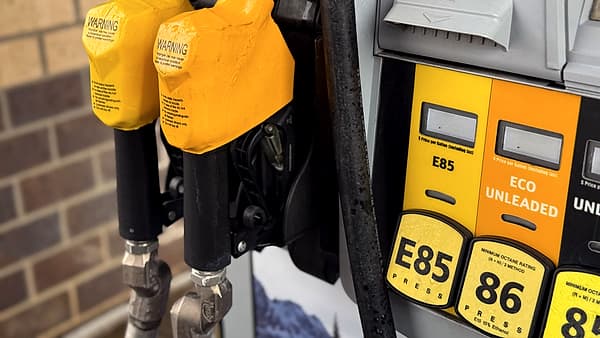
Fuel Pump Accuracy and the Octane Posted
Federal rules require retailers to post the automotive fuel rating on at least one label on each face of every dispenser, placed conspicuously near the price per gallon, and require every transfer to a non-consumer to be certified with a rating. The octane rating is the average of the research and motor octane numbers. Measurement accuracy is regulated by state weights and measures programs against a national technical standard, with devices tested and sealed.

Advertised Offers That Run Out
For retail food stores, offering products at a stated price by advertisement when the covered stores do not have them in stock and readily available during the advertised period is an unfair or deceptive act, unless the advertisement clearly discloses that supplies are limited or that the item is only at some outlets. Four defenses exist: adequate ordering, a rain check, a comparable substitute at the advertised price, or other compensation of at least equal value.

The Shelf Price Against the Price at the Checkout
There is no general federal rule requiring a store to charge the shelf price. Price accuracy is regulated by state weights and measures law, built on a national model that covers price verification and the method of sale, and enforced by state and county inspectors. Federal law reaches the subject through the prohibition on deceptive acts and practices, which bites where advertised prices are systematically not honored rather than where a single tag is stale.